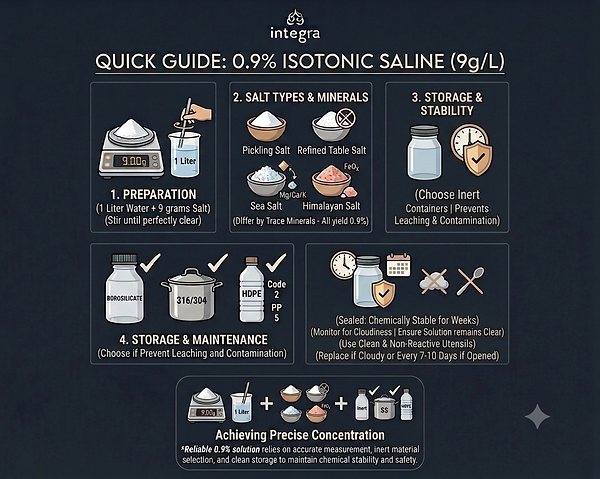
Quick Guide: 0.9% Isotonic Saline (9g/L)
1. Preparation
For a precise 0.9% NaCl concentration, use a digital scale.
-
Water: 1 Liter (Distilled or boiled/cooled tap water).
-
Salt: 9 grams.
-
Method: Combine in a clean vessel and stir until the solution is perfectly clear.
2. Salt Type & Mineral Profile
All types below yield a 0.9% solution at the 9g/1L ratio. The difference lies in the trace mineral content.
Pickling Salt - Pure NACl; no additives, iodine, or minerals.
Refined/Table - Often contained iodine and anti-caking agents.
Sea Salt - Rich in Magnesium, Calcium, and Potassium.
Himalayan - Contains Iron Oxide and various rock minerals.
3. Container Selection
Choose inert materials to prevent chemical leaching, ions migration, or microplastic contamination.
-
Optimal (Inert): Borosilicate or tempered glass. These are completely non-reactive.
-
High-Grade Metal: 316 or 304 Stainless Steel. Highly stable and corrosion-resistant, though glass remains superior for long-term storage of saline.
-
Stable Plastics: HDPE (Code 2) or PP (Code 5). These are BPA-free and more resistant to degradation than standard PET.
-
Avoid: Aluminum, copper, or low-quality plastics (PET/Code 1), as the salt content can facilitate the leaching of metals or chemicals into the water.
4. Storage & Stability
-
Stability: Salt acts as a natural stabilizer. In a sealed, inert container, the solution remains chemically stable for several weeks.
-
Maintenance: Use clean, non-reactive utensils to avoid introducing organic matter or metallic residues.
-
Refresh: Replace the solution if it becomes cloudy or every 7–10 days if the container is opened frequently.